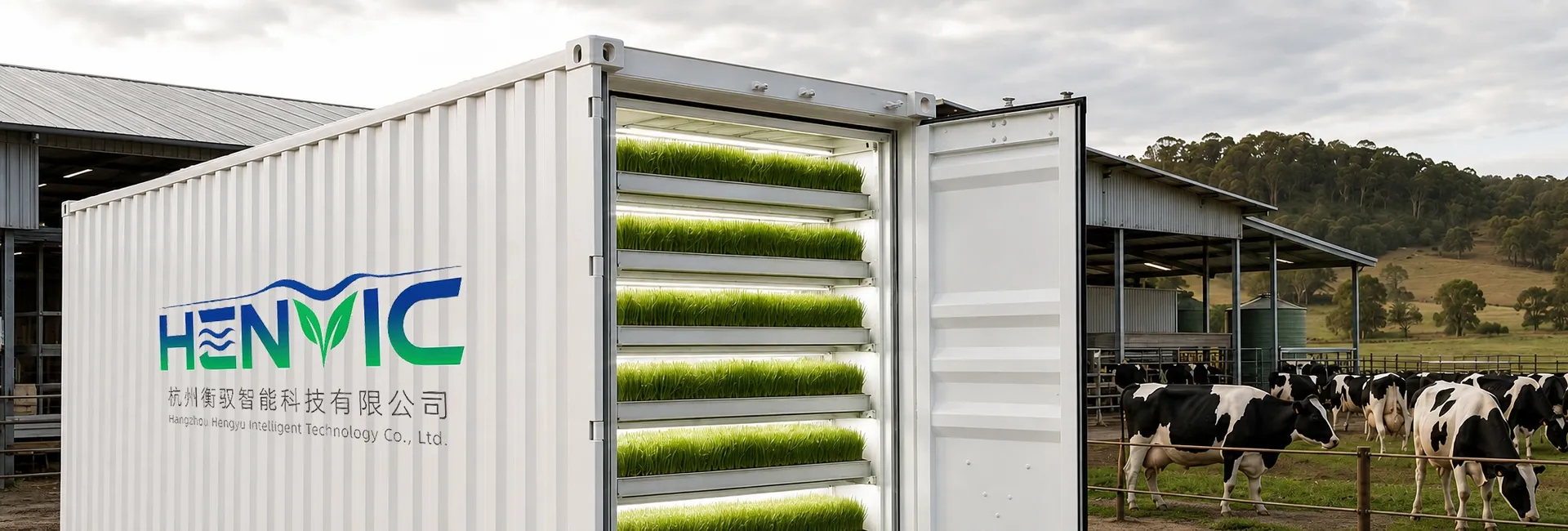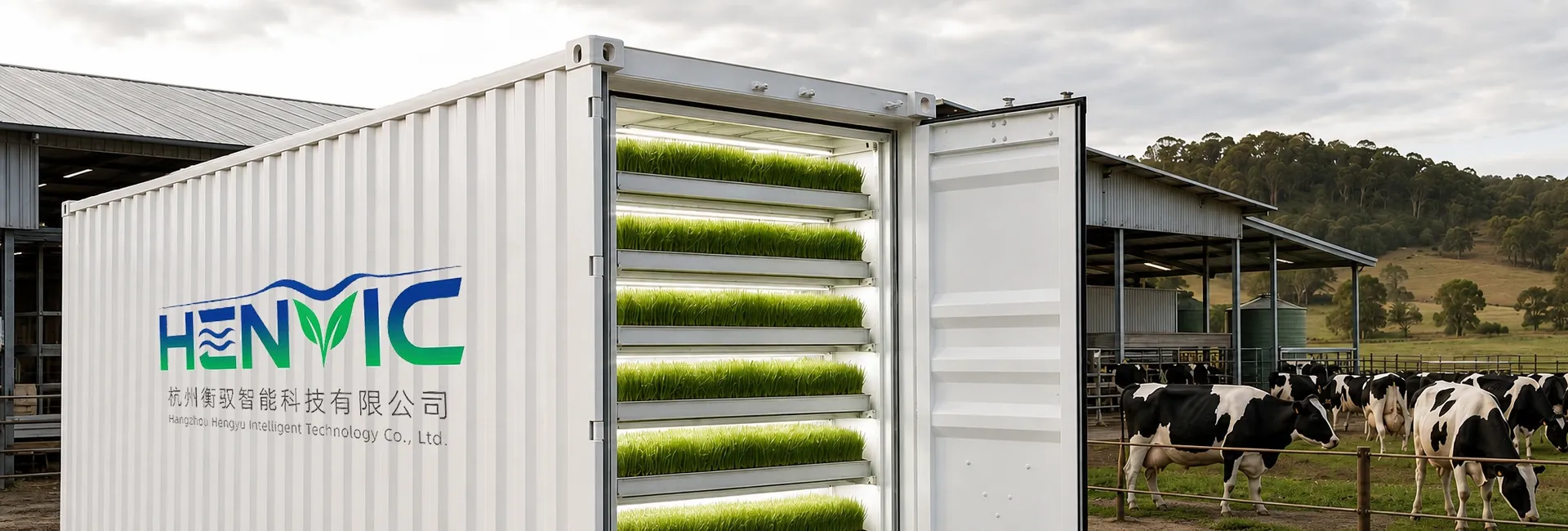
A shipping container farm is, at heart, a small sealed building with an artificial climate. Everything the plants need — temperature, humidity, airflow, carbon dioxide, and light — has to be created and continuously corrected by machines, because nothing about the box's natural state supports growth. Here is how that control loop is built and how it operates hour by hour.
The Principle: A Closed Loop That Refuses to Drift
In an open field, climate is a given. In a container, climate is a target. The control system constantly compares what it measures against what it wants, and acts on the difference. Sensors report conditions; a controller decides; actuators respond. This measure-compare-correct cycle runs continuously, typically every few seconds to a few minutes, and it never stops while the crop is growing.
Temperature: Cooling Is the Hard Part
Container farms generate heat from three sources at once: LED grow lights, pumps and fans, and the plants themselves through respiration. Because a steel box has almost no thermal mass and poor insulation by default, that heat builds quickly.
Most systems therefore index cooling rather than heating. An air conditioner or water-chiller loop removes the surplus, and insulated wall panels, sealed doors, and vapour barriers slow heat gain from outside. In cold climates a heater is added, but the design assumption is usually that the box will run warm, not cold. Temperature is held within a narrow band — often roughly 18 to 24 °C depending on crop — and the setpoint can shift by growth stage.
Humidity: Managing the Water in the Air
Transpiring plants release a large amount of water vapour into a small, sealed space. If humidity climbs too high, condensation forms on leaves and surfaces, and that is where mould and mildew begin.
Dehumidifiers pull moisture out of the air, while fans keep air moving so that no micro-climate stagnates around the canopy. The controller usually targets a relative humidity range and works with the temperature loop, since humidity and temperature move together — cooling air tends to raise its relative humidity, so the two systems must be tuned as a pair rather than independently.
Airflow and CO₂: Circulation as a Nutrient
Air movement serves three jobs: it removes the thin boundary layer of humid air around each leaf, it distributes heat evenly so the top and bottom racks stay similar, and it delivers carbon dioxide to the stomata.
In a sealed container, CO₂ drawn from outside may be insufficient, so many systems inject it and hold concentrations above ambient — commonly in the 800 to 1,200 ppm range — to accelerate photosynthesis. Perforated ducting or vertical fans push air through the racking, and the controller meters CO₂ injection against measured levels rather than running it constantly.
Light: Climate Control in Photons
Light is not separate from climate control — it is the largest input driving the whole system. LEDs run on a programmed photoperiod (for example 16 to 20 hours on, 4 to 8 off) and a defined spectrum for vegetative or flowering stages.
Because lights determine how much heat enters the box, the lighting schedule and the cooling load are directly linked. Dimming, zoning by rack, and shifting intensity across the day are all used to keep the energy balance manageable. When the lights go off, the cooling demand drops sharply, and the controller adjusts accordingly.
Putting It Together: A Day in the Loop
At lights-on, temperature and CO₂ injection ramp up as photosynthesis begins. Fans sustain airflow across the racks. As the crop transpires, dehumidifiers cycle on and off to hold humidity in range. Mid-cycle, the controller may nudge temperatures slightly to influence growth habit. At lights-off, the cooling load falls, humidity tends to rise, and dehumidification takes over as the dominant task. Sensors log all of it, and the setpoints are adjusted as the crop matures.
Where the Real Constraints Lie
The elegance of the design is that every variable is controllable. The cost is that every variable must be paid for in electricity — cooling, dehumidifying, lighting, and pumping are the dominant operating expenses. Reliability matters as much as performance: a chiller failure or a sensor drift in a sealed box can damage an entire crop within hours, so redundancy in critical components and alerting on out-of-range conditions are standard practice.
The climate control system is what turns a steel box into a growing environment. It is less a single machine than a coordinated set of loops — temperature, humidity, air, CO₂, and light — all chasing setpoints that shift with the crop and the hour. Get those loops right, and the container becomes predictable. Get them wrong, and the same box becomes a very expensive way to lose a harvest.
If useful, I can adapt this into a shorter version for a trade-magazine sidebar, add a labelled diagram description (vents, chiller, dehumidifier, CO₂ injection, sensor placement), or write it with a more technical engineering register.