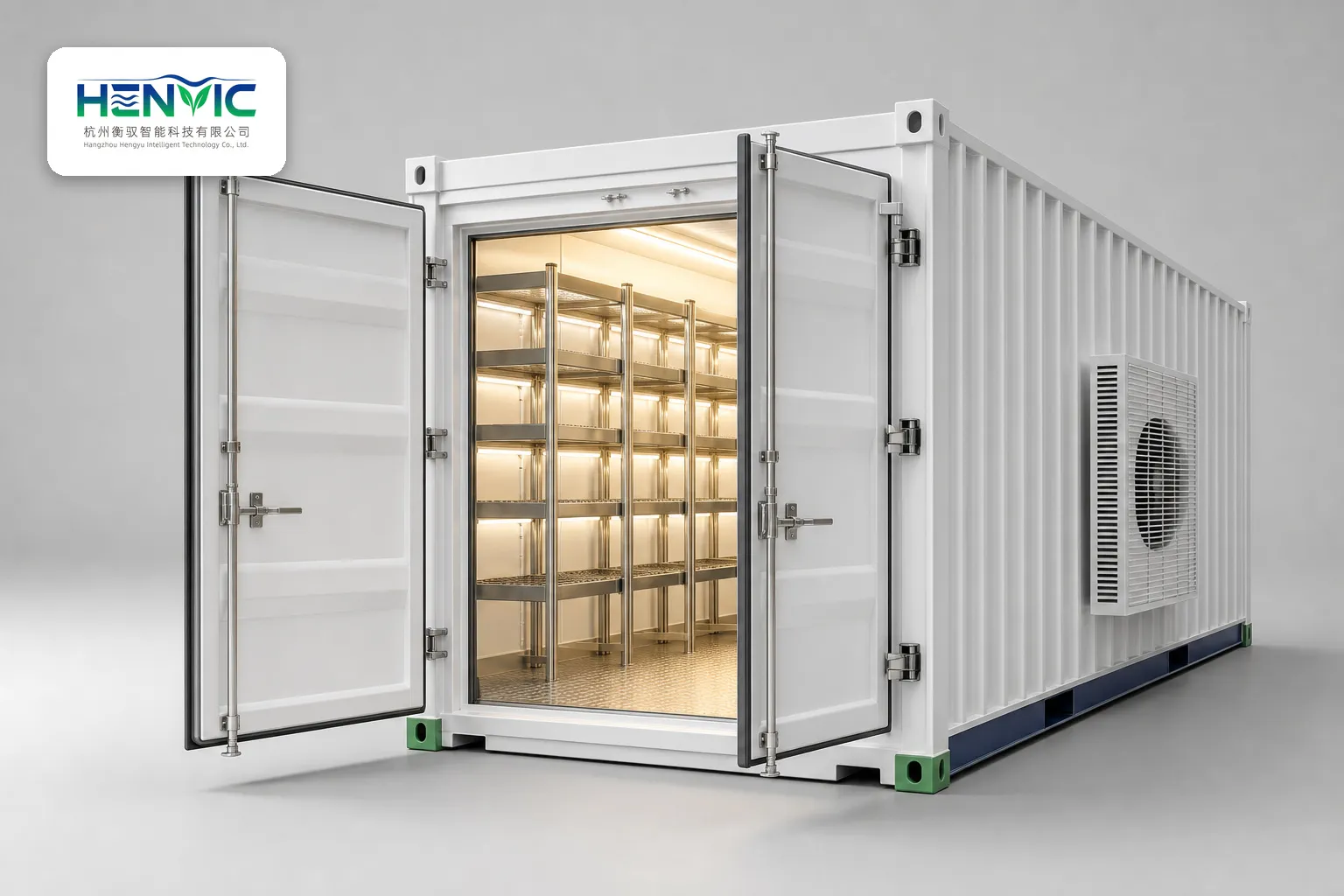
A mushroom cultivation container model is not a single machine but a configured production cell, and the configuration is dictated almost entirely by which phase of the fungal lifecycle it is asked to host. Because fungi pass through a vegetative colonisation stage and a reproductive fruiting stage with opposing environmental optima, the mushroom container industry has diverged from the plant container market in a specific way: instead of one general-purpose box, manufacturers offer a family of models differentiated by phase, by cultivation format (bag, log, bottle or tray), by container footprint, and by degree of automation. Understanding the model landscape is essentially understanding how builders partition an inherently two-stage biological process into hardware.
The Underlying Segmentation Logic
Three variables drive model design more than any other. The first is phase: colonisation demands warmth, darkness and elevated carbon dioxide, while fruiting demands cool air, intense fresh-air exchange and low CO₂. A single chamber cannot economically hold both setpoints, so models split along this line. The second is cultivation format: substrate blocks in bags behave thermally and spatially very differently from bottles on a conveyor, and from logs stacked on racks. The third is throughput scale, which determines whether a cell is a self-contained experiment unit or one module in a multi-container cluster.
Manufacturers therefore publish model families built on a shared envelope — almost always a standard intermodal footprint — but with phase-specific climate modules, racking and load handling inside.
Sizing Models: The Footprint Taxonomy
The core range is built on three envelopes.
The ten-foot micro container model is aimed at research institutions, teaching facilities, restaurants and pilot-scale validation. It hosts a single phase, typically fruiting, with two to four tiers and a live substrate capacity measured in tens to low hundreds of kilograms. Its value is recipe development: because the chamber volume is small, environmental shifts happen fast and the response is easy to observe. Residency time is short and the biological risk of a contamination event is contained to a small batch.
The twenty-foot standard model is the commercial workhorse. Configured for fruiting, it typically carries four to six tiers at 40 to 60 centimetres of usable height per tier and holds several hundred substrate blocks, depending on block mass and spacing. When configured for colonisation, the same envelope carries deeper, more densely packed racking because light and airflow uniformity are less critical and thermal mass is the priority. Twenty-foot models are the most common unit of sale because they fit standard transport, sit within most zoning allowances and can be delivered pre-commissioned.
The forty-foot high-cube model is the high-throughput unit. With ceiling height approaching 2.7 metres internally, it accommodates eight to twelve fruiting tiers or serves as a combined processing hall — substrate mixing, bagging and sterilisation loading at one end, climate-controlled growing at the other. Forty-foot models are usually deployed in clusters and are the only envelope where walk-behind or conveyor-based harvest handling is genuinely practical.
Phase-Specific Models
The incubation or spawn-run model is defined by its ability to remove metabolic heat rather than add it. Actively growing mycelium generates heat, and dense block packing can push substrate temperature several degrees above ambient — precisely the condition that favours competing moulds. A well-specified incubation model therefore pairs moderate air temperature control, typically 22 to 26 degrees Celsius, with conductive cooling through rack surfaces and forced air through the tier stack, holding carbon dioxide deliberately high at 5,000 to 20,000 parts per million and light near zero. Racking is dense, load-bearing and designed for easy block in-and-out. Some models add substrate-probe channels so core temperature can be logged per block rather than inferred from air.
The fruiting or flush model is the opposite machine. Its defining subsystems are fresh-air exchange and high-capacity humidification, because the transition to fruiting is triggered by driving CO₂ down below roughly 800 to 1,000 parts per million while holding humidity in a band that keeps caps turgid without depositing free water. Temperature is held in species-specific bands, typically 13 to 20 degrees Celsius for gourmet types, with a programmable cold-shock ramp. Low-intensity blue-rich lighting at 200 to 1,000 lux for 8 to 12 hours is standard, both to direct stem orientation and to develop cap colour and pigmentation. Racks are shallower than in incubation models because fruit bodies need vertical clearance and lateral airflow.
The cold-shock or finishing model is a stripped, high-refrigeration variant used for species that require a sharp temperature drop and a defined light cue to synchronise pinning. It is less common as a standalone purchase and more often specified as a sub-zone within a fruiting model, achieved by splitting the chamber into independently controlled bays.
Cultivation-Format Models
Bag and block models dominate the gourmet segment. They are optimised for flexible block geometry, tolerant of manual handling and suited to supplemented sawdust substrates. Racking is adjustable and access is by full-height doors or roll-up curtains, with tier spacing set by the tallest expected fruit body rather than by the block itself.
Log and bed models serve shiitake and wood-loving species. They are distinguished by heavy-duty racking able to carry water-saturated logs, by airflow designed to sweep along the log axis rather than across it, and by humidity systems capable of sustaining the high surface moisture that log cultivation requires during soaking and fruiting.
Bottle models are the industrial extreme. They serve enoki, king oyster and other species grown in polypropylene bottles on pallets or conveyor lines, and the container becomes a climate envelope wrapped around a materials-handling system: depalletisers, watering and thinning stations, and robotic or semi-automated harvest lines. Bottle cells are the least flexible in crop mix and the highest in capital cost, and they only make economic sense at multi-container scale with a dedicated sales channel.
Tray models sit between. They suit button mushroom-type production and standardised gourmet varieties where uniform substrate depth and repeatable per-tray yield matter more than block flexibility.
Automation and Control Tiers
Most manufacturers offer three control tiers across the same envelope.
The manual or entry tier provides independent PID loops for temperature, humidity and CO₂ with local HMI, fixed recipe recall and no remote access. It suits pilots and small producers and is the least expensive configuration.
The recipe tier adds staged, time-based recipe execution — programmed ramps for colonisation, cold shock, flush and rest — plus data logging, alarm limits and remote telemetry. This is the commercial default, and it is the tier at which a growing recipe becomes a transferable asset rather than an operator's tacit knowledge.
The networked tier integrates multiple cells under a shared supervisory system, shares chilled water, CO₂ supply and air handling across containers, and adds predictive logic: condensation-risk forecasting from the temperature-humidity trajectory, off-gas or volatile-organic-compound monitoring as an early contamination indicator, and yield tracking per block or per tier. Advancements at this tier are increasingly in software, because the biological failure modes — green mould during colonisation, condensation on cap surfaces, high-CO₂ elongation during fruiting — are well understood and benefit more from better anticipation than from bigger compressors.
Reading a Specification Sheet
A model's real capability shows in a handful of parameters rather than in headline capacity. Cooling capacity and the achievable substrate-temperature pull-down rate matter more than air setpoint range in an incubation model. Fresh-air exchange rate coupled to humidification turndown defines the usable operating band in a fruiting model, since every cubic metre of fresh air strips moisture that must be replaced. Temperature uniformity across tiers, not single-point accuracy, determines batch consistency. CO₂ sensor range and response time matter because fruiting hinges on a low-CO₂ threshold, and a slow or drifting sensor silently ruins morphology. For clusters, chilled-water supply temperature and shared utility capacity frequently become the binding constraint before any individual container does.
Selection Guidance
The practical rule is to specify by species and phase first, then by format, then by scale. A producer running oyster mushrooms in bags needs a fruiting model with strong fresh-air exchange, aggressive CO₂ control and species-specific cold-shock capability, paired with a separate incubation model that prioritises heat removal over lighting. A producer growing shiitake on logs needs racking and humidity designed for saturated wood, not high-density block cooling. A high-volume enoki operation needs a bottle cell whose envelope is effectively a materials-handling line, not a racking box.
A mushroom container model is ultimately a productised answer to a specific biological problem, and a model's specification is a statement about which failure mode it is engineered to prevent. In an incubation model, that failure mode is competitor mould driven by self-generated heat. In a fruiting model, it is stunted or deformed fruit bodies caused by residual carbon dioxide, free surface water or a missed light and temperature cue. Models that cluster across a shared utility backbone exist because neither phase alone is a business — the two-stage biology is the product line, and the hardware simply draws the boundary between its acts.