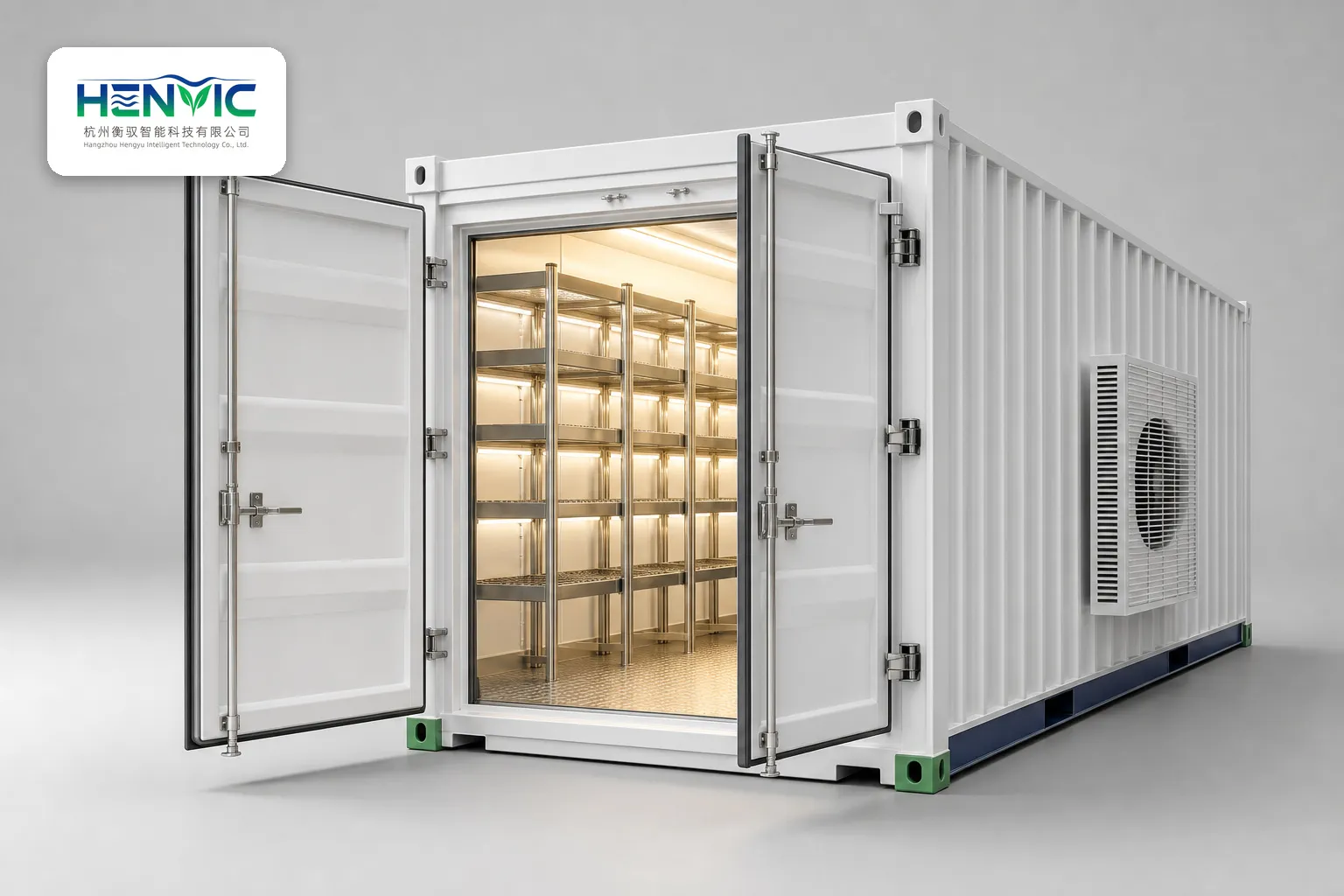
The container format for mushroom production has moved past the prototype stage. Across the past two years, a set of operating deployments — documented in local government releases, industry media and plant-factory demonstrations, mostly in China — shows what actually determines whether a "grow pod" earns money. The pattern is consistent and it is not about the box. In every case that worked, the container was the last problem solved; the first problems solved were crop selection, substrate supply, cycle synchronisation, and a channel that had already agreed to buy the output.
What follows is a case-by-case account of the deployments with verifiable reported figures, followed by a cross-case analysis of the mechanisms that produced those results, and a replication checklist. All numbers are as reported by the sources named; conversions to US dollars are approximate and provided only for scale.
Case 1 — Miyun, Beijing: Repurposing Idle Assets into a Seven-Day Fruiting Cycle
Site and origin. At an ecological farm in Henanzhai Town, Miyun District, a set of abandoned modular cabins was retrofitted into smart mushroom fruiting rooms rather than demolished. This is the single most important design fact about the case: the shell was free. Capital that would otherwise have gone into purchasing purpose-built containers was redirected into racking, climate control and the control system.
Configuration. Inside each cabin, white substrate blocks are stacked on purpose-built shelving in a clean, organised layout. Temperature, humidity, light and ventilation are managed by a digital control system that the operator runs remotely from a phone — a detail that matters more than it sounds, because it means one person can supervise several pods instead of being stationed in each.
Crops. Oyster mushroom (Pleurotus), king oyster (Pleurotus eryngii) and a small-format "mini oyster" type — the forgiving, fast-turning segment of the market.
Reported performance. One cabin holds 1,000 substrate blocks. From the moment blocks enter the pod to harvest is seven days, and a single flush from one pod yields about 500 jin — roughly 250 kg. At a reported market price of 8 yuan per jin (about 16 yuan per kg), that is approximately 4,000 yuan of incremental revenue per pod per seven-day cycle, or on the order of USD 560. The product was reported as in short supply relative to demand, and laboratory testing was said to show quality indicators superior to conventionally grown equivalents.
Why it worked. Three things, in order. First, the asset-reuse decision removed the largest barrier in the format — shell capital — and with it much of the payback risk. Second, a seven-day block-to-harvest cycle is short enough that scheduling errors are cheap and recovery is fast; the pod can be emptied, cleaned and reloaded within a week. Third, remote single-phone supervision collapsed the labour line, which is the dominant recurring cost in fresh mushroom production. The reported "closed-loop water recycling plus precision fertilisation" and full data logging from block entry to packaging are supporting features, but the economics were won on the three points above.
Case 2 — Yuxi, Yunnan: Containerising a Rare Species and Exporting the Result
Site and scale. A cultivation base in Yuxi operates a row of standardised mushroom pods, each holding 2,000 substrate bags, with ten pods in total brought into service.
Crop and the strategic choice. The base is not growing commodity oyster mushrooms. It is growing a species that previously could only be obtained by wild collection, brought into production through domestication and selective breeding. The operator's own benchmark is deliberately modest: the cultivated fruit's aroma reaches roughly seventy to eighty percent of the wild product. That framing is itself instructive — the business was not built on matching wild quality, but on delivering a recognisable version of a scarce product at a volume and price that wild collection never could.
Reported performance. After a pod is sealed, the first batch reaches harvest standard on day eight. Individual bag yield is reported at 300–350 g, giving roughly 750 kg per pod per cycle. Net income per pod per cycle is reported at about 15,000 yuan — on the order of USD 2,100.
The environmental regime. The reported setpoints are unusually warm for a mushroom crop and are worth quoting precisely, because they explain why this crop could not be grown outside a controlled shell: temperature strictly held at 30–35 °C, humidity at 90–95%, no light for the first three days after planting, then continuous illumination through to the end of harvest. Humidification and ventilation were credited specifically with stabilising pinning uniformity — the synchronisation of fruit-body initiation across 2,000 bags.
Channel. The output is processed into dried mushroom and sold into Singapore, Germany and France. Rolling, staggered harvesting across the ten pods keeps a continuous flow to the drying line rather than a single seasonal glut.
Why it worked. This case is the clearest demonstration of the price-gap logic. Commodity fresh mushrooms in the same market were reported at 2.65–5.9 yuan per jin (king oyster 2.65, enoki 2.75, oyster 3.55, fresh shiitake 5.9), while rare species traded at 15–30 yuan per jin (matsutake-class 15, termite mushroom 16, Boletus 30). A container's capital and energy cost is essentially the same whichever crop is inside it, so the format's viability is decided by whether the crop sits above or below the cost line. Pairing that with a dried product also neutralises the container's weakest point — fresh mushrooms are labour-intensive to grade, pack and move, and a dehydrated product has a long shelf life, low transport cost and an export-ready specification.
A useful contrast from the same report. The same operator runs a complementary under-forest, mimic-wild project on just over 150 mu of woodland, reported at more than 700 jin per mu, an average price of 18–20 yuan per jin, total output value above 2 million yuan, and, since March of that year, 4,000 labour-days and over 700,000 yuan in wages paid to local villagers. The two channels are not competing: the pods supply standardised, traceable volume for export processing; the forest plot supplies the premium "wild-like" story. The container did not replace the field — it took the segment where consistency is worth more than terroir.
Case 3 — Luquan, Shijiazhuang: The Container as a Multi-Crop Platform
At a demonstration base run by Hebei Plant Biotechnology Co. in Luquan District, ocean shipping containers are converted into what the coverage calls "four-season farms." The reported crop mix is the point of interest: the smart pods are used for golden ear fungus (Tremella mesenterica, a high-value gelatinous species), together with strawberry and Dendrobium (a medicinal orchid). The stated achievement is breaking natural seasonal and climatic limits to achieve stable year-round output.
Read as a case study, this deployment demonstrates a different proposition from Cases 1 and 2. Here the container is not a mushroom farm; it is a reusable environmental platform whose value is the ability to reconfigure the same shell for very different organisms — a gelatinous fungus, a fruiting crop and a medicinal orchid each want different temperature, humidity and light regimes. That is a stronger business argument than single-crop production in one respect (asset utilisation is not tied to one market) and a weaker one in another (a room optimised for nothing in particular is usually mediocre at all three). The demonstration-base framing should be read accordingly: it is a capability showcase for equipment sales, not a published profit-and-loss statement.
Case 4 — Ningbo: Quality and Grade as the Measured Outcome
Coverage of containerised mushroom production in Ningbo reports golden oyster mushroom (Pleurotus citrinopileatus) grown inside containers, with the operator presenting a direct comparison against conventional production and attributing the difference to yield and, notably, to product appearance and grade. The full figures from that report were not retrievable at the time of writing, so the case is included here only for the direction of its claim — that in the container format, the most visible early win is often not volume but the proportion of crop that reaches the top grade. Grade-out, not gross yield, is where container economics are usually won or lost, and this is the one reported outcome that points squarely at it.
Cross-Case Analysis: The Five Mechanisms Behind the Results
1. Crop selection precedes equipment selection. The Yuxi case is decisive on this point. A pod producing king oyster mushrooms at 2.65 yuan per jin cannot service a pod producing a rare species at 16–30 yuan, using identical capital and energy. Every deployment that reported meaningful net income was growing either a scarce, domesticated species or a product form (dried, exported) that escapes the commodity price floor. The container's contribution is to make a temperature regime of 30–35 °C with 90–95% humidity and a three-day dark phase followed by continuous light repeatable — which is what allows a wild-only species to be sold at industrial volume.
2. Cycle compression is the real productivity lever. Reported harvest intervals are seven days in Miyun and eight days in Yuxi. Compare that with a conventional mushroom house cycle, which typically runs several weeks from spawn run through multiple flushes. What the compressed interval buys is not just more flushes per year — it is schedulability. A seven-day cycle means a contamination event costs one week, a labour gap costs one week, a price dip costs one week, and the operator can align harvest days to delivery days. Pinning synchronisation, credited explicitly in the Yuxi report to humidification and ventilation control, is the technical enabler: unsynchronised pinning turns a "harvest day" into a rolling two-week drag.
3. Stage separation, with substrate produced off-line. Both high-performing cases load finished substrate blocks or bags into the pod. Neither runs composting, pasteurisation, inoculation and fruiting inside the same shell. This is the architectural decision that makes the short cycle safe: the contamination-critical, odour-generating, capital-intensive work happens once, professionally, in a central facility, and the container becomes a clean, replaceable process cell. A vendor pitch that promises "everything in one box" is describing a scheduling and contamination problem.
4. Capital avoidance beats capital efficiency. The Miyun case's competitive advantage is that its shells were free. Retrofitted cabins, decommissioned modular buildings and second-hand containers convert a sunk cost into a revenue asset and move the payback calculation entirely onto the equipment inside. For operators without that option, the practical equivalent is to buy the smallest shell that fits the racks and to spend the difference on latent cooling capacity, redundant sensing and a real drainage and wash-down floor.
5. Traceability as a sales asset, not a compliance chore. The Miyun report states that every step from bag entry to harvest and packaging is data-recorded and traceable, and that testing showed superior indicators to conventional product. The Yuxi operation's dried product reaches Singapore, Germany and France — markets where documentation, not taste, is the entry ticket. In both cases the control system's logging function is doing double duty: it optimises yield inside the pod and it justifies the price outside it. An operator who can produce a per-batch environmental record can access channels that pay a premium; one who cannot is stuck at wholesale.
The Industry Frame These Cases Sit Inside
Reported sector context for 2026 gives the cases their commercial logic. China's edible-mushroom export value was forecast at about USD 4.5 billion, with flows concentrated into Southeast Asia, Japan and Korea, and Europe; freeze-dried and dehydrated products account for more than 60% of export value, precisely because they solve the storage-and-transport constraint that limits fresh-mushroom trade. Domestic per-capita consumption was projected to rise from 3.2 kg in 2025 to 3.5 kg in 2026, driven by low-fat, high-protein positioning. Concentration is increasing: the top ten firms were reported at a combined 32% market share, up 1.5 points year on year, with leaders extending upstream into strain development and substrate production and downstream into branding and logistics. High-end strains and some specialty substrates remained import-dependent, though self-sufficiency was reported at 85%. Patent filings were reported up roughly 20% year on year, concentrated in environmental-control algorithms, biological pest and mould control, and residue valorisation — which is a fair description of exactly where containerised operations still lose money.
What the Success Cases Do Not Claim
It is worth being precise about the limits of this evidence, because the format is easy to over-sell.
None of these reports publishes a full cost structure. Reported "net income per pod" figures do not disclose electricity, substrate purchase, spawn, labour, packaging, cleaning or the loss rate, and per-pod revenue is not per-pod profit at the enterprise level. All figures come from local government communications, regional media and vendor demonstration coverage rather than audited accounts, and they describe single sites in favourable market niches with either free shells or a protected price premium. Currency conversions are approximate. Reported prices are wholesale/market snapshots from a specific period and are volatile.
The structural fragility that remains in every case is the same: one pod is one point of failure. A compressor fault, a Trichoderma outbreak or a harvest-labour gap stops the entire pipeline. The deployments that reported stable output did so by running multiple pods on staggered cycles — ten in Yuxi, several in Miyun — which is what converts a container into a production system. That redundancy is the actual product.
A Replication Checklist Derived From These Cases
1. Price the crop before specifying the pod. If the target species trades near the commodity floor, the container will not fix it; if it trades at a scarcity premium, the container is the mechanism that makes the premium repeatable.
2. Decide the product form early. Fresh, dried, freeze-dried or extracted. Dried and freeze-dried formats unlock export channels and remove the shelf-life cliff — which is what the Yuxi export business is built on.
3. Buy finished blocks or build a separate substrate line — do not combine them in one air path.
4. Specify for step change, not for setpoint holding. The ability to move a room from a dark 30–35 °C colonisation regime to a lit, high-humidity pinning regime on schedule is the specification that produced the eight-day cycle.
5. Design for a one-week turnaround: drain, wash-down floor, cleanable rack feet and cable penetrations, and a documented clean-out protocol. Contamination pressure escalates batch over batch in a pod that cannot be properly washed.
6. Instrument both ends of the room and log per batch. Traceability records are a pricing asset, and single-sensor control is the most common cause of two grades from one harvest.
7. Run N+1 pods on staggered cycles and treat the stagger as the production plan.
8. Secure the offtake before the first flush — a restaurant contract, a processor, an export trader, or a drying line. The Miyun case's "supply cannot meet demand" and the Yuxi case's export channel were both pre-existing commercial positions, not consequences of the technology.
9. Count the unbudgeted infrastructure: three-phase electrical service, water supply, condensate and wash-water disposal, crane or dock access for delivery and set. Containers get delivered to sites that cannot feed them.
10. If a decommissioned shell exists, retrofit it. Asset reuse is the highest-return decision available in this format.
The honest summary of this body of evidence is that containerised mushroom growing has been proven as a deployment pattern, not as a general business. It succeeds where the crop commands a premium that the environment controls can reliably earn, where substrate arrives finished, where the cycle is compressed to a week, where several pods stagger against one another, and where someone has already agreed to buy the output. Every case above satisfies those conditions; the failures in this market almost always omit one of them — and the omitted condition is rarely the container.

On evidence: the figures in this article are those reported by the underlying sources — the Miyun District People's Government portal (25 December 2025), industry and regional media coverage of the Yuxi and Ningbo operations (October 2026 and the corresponding period), and International Online / CRI reporting on the Shijiazhuang demonstration base (17 December 2025). They are site-level, self-reported and unaudited, and revenue figures are not disclosed as full profit-and-loss. Sector-level export, consumption and market-share figures are forecasts or estimates as reported. Food-safety, certification and traceability obligations differ by country and destination market and are revised over time; confirm against the current requirements of the relevant authority before building or making any compliance or export claim.